
During the manufacture of electrical chips probably everyone has used capacitors at some point and maybe had no idea about it. Capacitors are usually used to mitigate voltage or current fluctuations, load interactions, as well as a power source for low-power devices, and so on.
There is currently a wide range of manufacturing techniques that use different raw materials with unique properties to make capacitors. To select a capacitor that suits your needs best and to prevent various possible problems (e.g. with temperature stability) from arising, you need to understand how these devices work.
Principles of operation and technical features
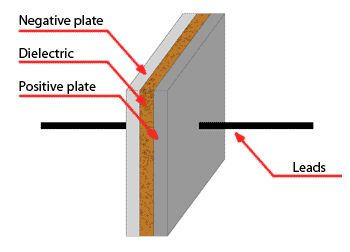
The easy-to-use capacitor consists of current-carrying sheets separated by an insulator. The charge accumulates on these sheets, but does not pass further because of the insulating properties of the built-in dielectric. Thus, the capacitor accumulates charge.
The unit of measurement, the farad (F), measures the capacitance of the capacitor, for example: one farad of the capacitor emits voltage of 1 W if it contains a charge of one coulomb (С). You can find capacitance in micro, nano and picofarad in some models of supercapacitors. It is possible to deduce the capacity of your capacitor from its size and the characteristics of the insulator: the capacitance is proportional to the dielectric constant of the dielectric used, leading to the sale of many capacitors that use different insulating materials to achieve large capacitance or improve voltage characteristics.
Parasitic inductance and capacitor resistance
Along with providing the required characteristics each type of dielectric has its own slightly inconvenient features that it exhibits during usage. All capacitors have low parasitic resistance and inductance, which affect the operation of the device. Electrical constants are modeled depending on temperature, voltage or piezoelectricity.
The different types of capacitors and their properties, cons and pros, are described in detail in the next part of the article. Of course, not all available technologies are covered, but most of the general ones are described.
Electrolytic aluminum capacitors
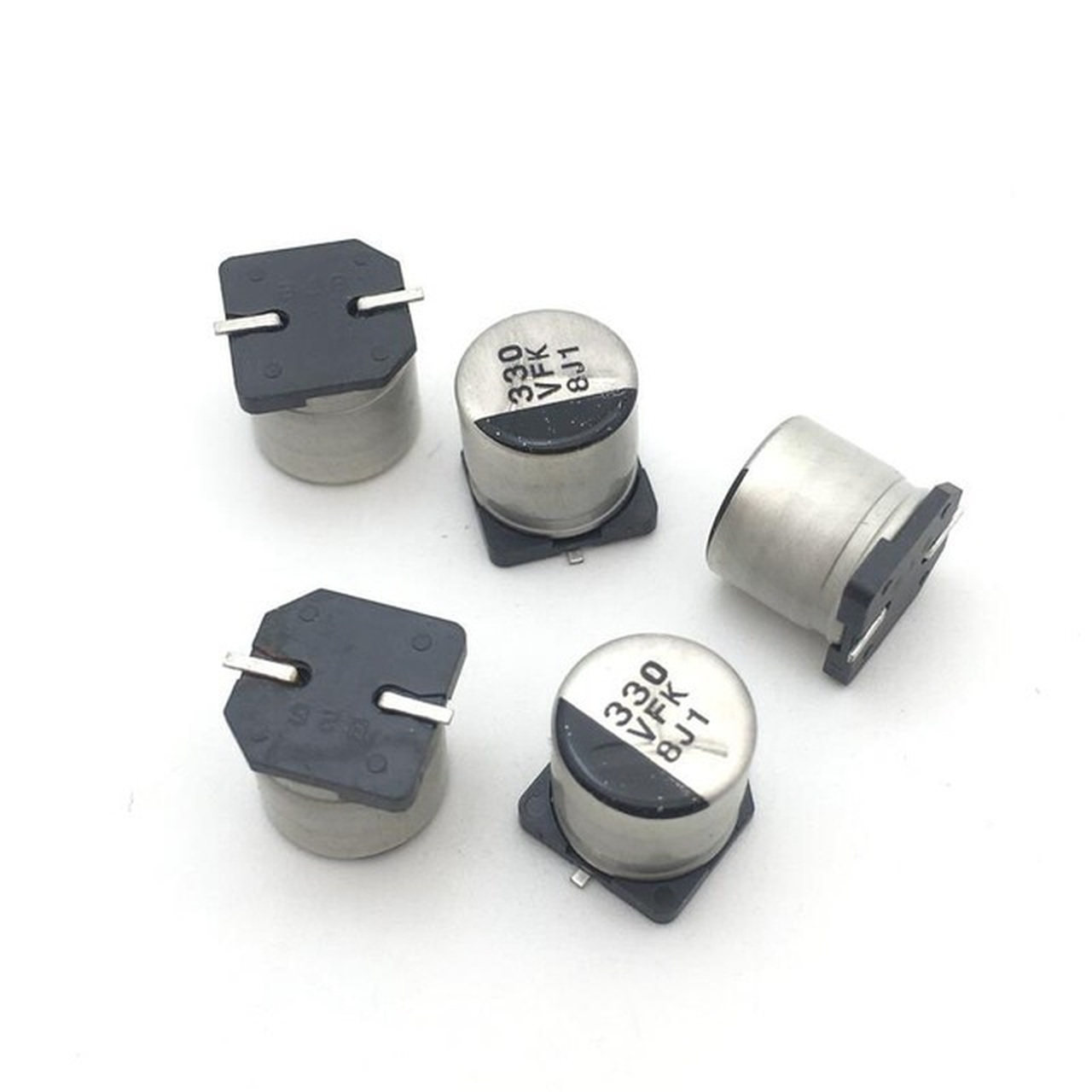
This type of capacitor consists of one dielectric plate based on an anode-oxide layer on an aluminum (Al) sheet, and a subsequent electrolyte plate from an electrochemical cell. Thanks to the electrochemical cell, the capacitors become polar, in other words, the DC voltage will flow in a certain direction and the anodized plate will be with a positive charge or +.
In fact, the plates of the capacitor are made in the form of layers made of aluminum foil, wrapped in a cylinder and placed in an aluminum can. The rated voltage depends on the thickness of the anodized layer.
Electrolytic aluminum capacitors are part of the group of SMD capacitors and have the largest capacity among commonly used components, from 0.1 to thousands of uF. The tight packing of the electrochemical cell creates a large equivalent series inductance (or effective inductance), so they cannot be used at high frequencies. Quite often they are used to ‘smooth out’ the power supply and disconnection.
Capacitors with polymer films
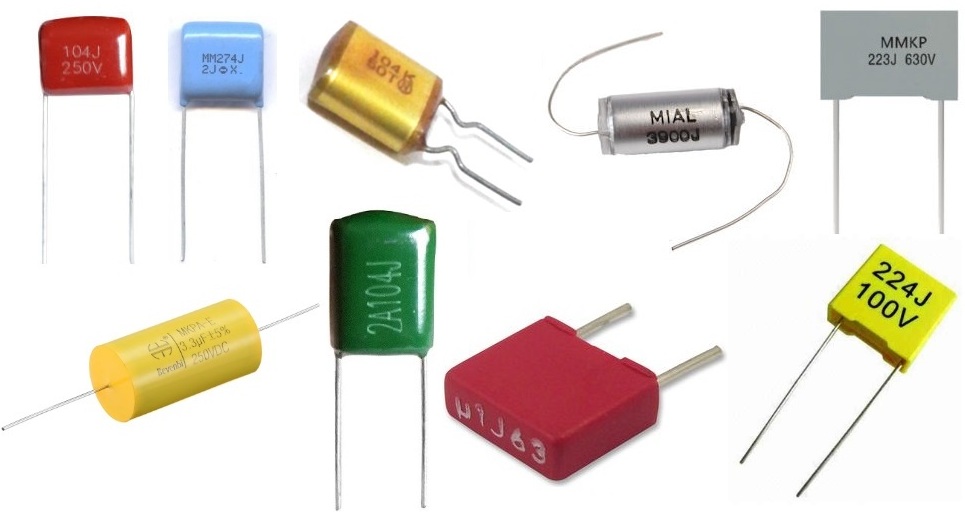
There is a group of capacitors in which polymer films are used as insulators. The film alternates with twisted sheets of metal foil, or has a metallized sheet on the surface. The voltage of such devices reaches up to 1000 V, but film capacitors are not endowed with a large capacity, which in general ranges from 100 pF to several uF . Different variations of films have their advantages and disadvantages, but in general the whole group has a lower capacitance and inductance, compared with electrolytic devices, so they are used in different areas.
Polypropylene capacitors are used in circuits, where good thermal and frequency stability is required, in power supply systems, or where the use of alternating currents of maximum voltage is required.
Capacitors made of polyester film do not differ in terms of frequency and heat stability, but they are cheap and can withstand high temperatures during soldering during surface mounting.
- Polyethylene naphthalate capacitors are similar to polystyrene ones, but can withstand even greater stress and temperature.
- Polyethylene sulfide devices do not differ much in characteristics when compared with polypropylene capacitors, but can endure high temperatures.
Previously, polycarbonate and polystyrene capacitors were also used, but now they are inferior in performance to modern films.
Tantalum electrolytic capacitors
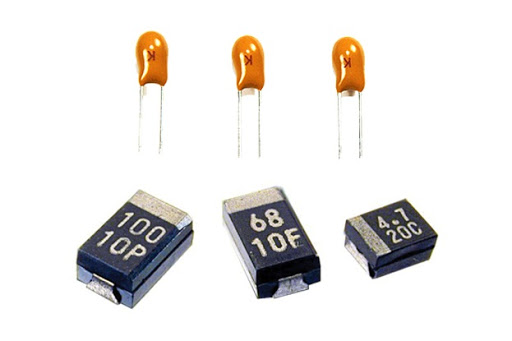
This type of capacitor, which is also part of the SMD capacitors group, has a tantalum anode and a surface on which a heavy layer of oxide is applied, and then an electrolyte of manganese dioxide is created as a cathode. The combination of a wide surface area and insulating characteristics of tantalum oxide causes a large capacity based on volume. As a result, these devices have smaller dimensions of comparable capacity to aluminum capacitors. Tantalum devices have polarity, which is why direct current should flow in only one direction.
The possible capacity ranges from 0.1 to several hundred uF. These capacitors have low leakage resistance and equivalent series resistance (ESR), so they are used in the testing of measuring instruments and in audio devices of the highest quality.
Speaking of tantalum capacitors, care must be taken to ensure that they do not fail – in which case they might ignite! Tantalum oxide with amorphous properties is an excellent dielectric, but in crystalline form it turns into a good conductor. One example of an improper use of a tantalum capacitor would be supplying a much more powerful than needed starting current that will change the dielectric to a crystalline form, which in turn will increase the current flowing through it. However, modern methods of creating these capacitors provide more reliable devices.
Ceramic capacitors
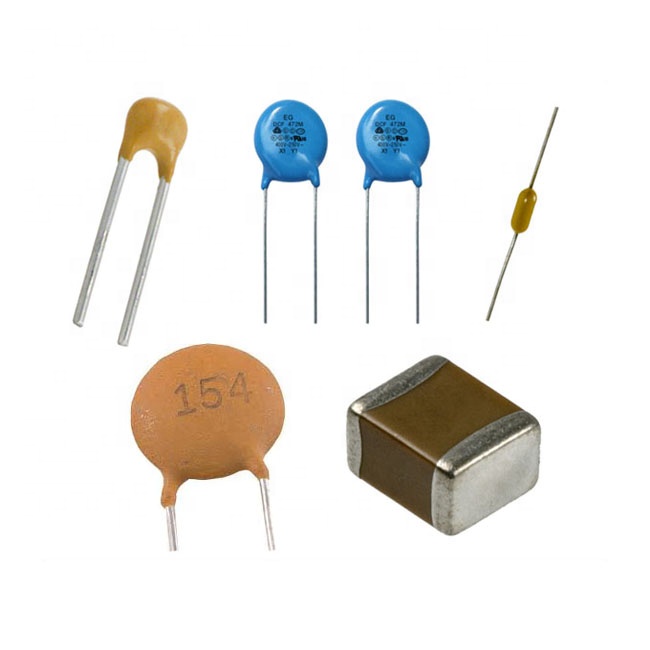
The history of ceramic capacitors goes back way into the past: they were used from the first decades of the 20th century to the present day. Previously, capacitors had one layer of ceramic, metallized on all sides. More modern devices are multilayered, where the sheet-plate is covered with metal and alternates with ceramics.
Depending on a dielectric the capacitance can be from 1 pF to 10 μF, while the voltage reaches kilovolts. Ceramic capacitors are used when small capacity is necessary, so there are both single-layer ceramic and multilayer capacitors for surface mounting.
Classification of ceramic capacitors
The most convenient way to divide ceramic capacitors into groups is by dielectrics, because they are endowed with different properties. Classification is based on three-letter codes, which encrypt their operating temperature and stability.
- C0G capacitors have indisputable stability in capacitance with respect to t°, frequency and voltage; used in high-frequency circuits, for example.
- X7R devices are mostly suitable for general applications and disconnection purposes.
- Y5V components have a good capacity, but their endurance in temperature and voltage is pretty low; used similarly to X7R devices.
Quite often ceramics have piezoelectric properties, so such capacitors have a microphone effect. When working with high voltage and frequency in audio bands, and in the case of tube amplifiers or electrostatics, you can hear the sound of capacitors. When using a piezoelectric capacitor to implement frequency stabilization, its sound is changed by the vibration of its environment.
Information taken from the HACKADAY article 

In order to get qualified advice on various capacitors and buy them in Ukraine, please contact the office of SEA Company by phone: +38 (044) 330-00-88 or write an e-mail: info@sea.com.ua.